
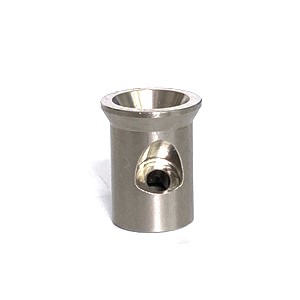
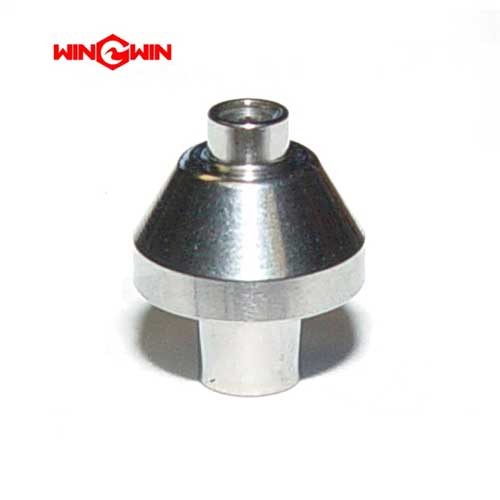
New Model Mixing Chamber / Mixing Chamber (Part No. 510000513)
Product Name: New Model Mixing Chamber / Mixing Chamber (Part No. 510000513)
Description:
This component is a new model mixing chamber, also known as an abrasive mixing body or Venturi block, specifically designed for abrasive waterjet cutting systems . It is a precision-machined stainless steel housing that serves as the central component where the ultra-high-pressure waterjet and garnet abrasive particles combine to form the cutting stream .
The mixing chamber features an optimized internal Venturi geometry that creates a vacuum to draw abrasive particles through a side inlet port . This "new model" designation typically indicates improvements over legacy designs, which may include enhanced wear resistance, optimized flow dynamics for better abrasive mixing efficiency, or redesigned sealing interfaces for improved reliability . It is rated for continuous operation at 60,000–90,000 PSI (approximately 4,137–6,200 bar).
Applications:
Core mixing component in abrasive waterjet cutting heads for hard material cutting
Positioned between the jewel orifice (water nozzle) and the focusing tube (mixing tube)
Provides the internal Venturi geometry for abrasive suction without moving parts
Suitable for both standard and ultra-high pressure waterjet systems
Features:
Optimized Venturi Geometry: Precision internal bore creates consistent vacuum for stable abrasive draw
Stainless Steel Construction: High-strength, corrosion-resistant body material for long service life
Improved Wear Resistance: Enhanced internal surfaces resist erosion from high-velocity abrasive flow
Side Abrasive Inlet Port: Designed to introduce garnet at an optimized angle into the waterjet stream
60,000–90,000 PSI Rating: Engineered for continuous ultra-high pressure operation
New Model Enhancements: May include improved sealing interfaces, better flow dynamics, or tool-free maintenance features
Maintenance:
Failure Diagnosis:
Abrasive Flow Interruption: If abrasive fails to draw into the cutting head, the mixing chamber may be worn or blocked
Reduced Cutting Performance: Gradual loss of cutting speed or edge quality indicates internal chamber wear
Backflow (回水): Water backing up into the abrasive feed tube is a primary indicator of a worn mixing chamber
Vacuum Pressure Drop: A decrease in the negative pressure gauge reading suggests venturi wear or blockage
Inspection and Replacement Procedures:
Inspect Internal Bore: Regularly check the internal bore for signs of erosion, wear grooves, or diameter enlargement caused by abrasive particles. Excessive wear will degrade mixing efficiency and cut quality
Check Inlet Edge: Visually inspect the inlet bore edge for rounding or erosion. If edge wear is significant, mixing efficiency drops noticeably
Clean Debris: During cutting head maintenance, remove the mixing chamber and thoroughly clean any compacted abrasive debris or residual particles to prevent blockages
Coaxial Alignment: Ensure the jewel orifice, mixing chamber, and focusing tube are perfectly aligned during reassembly. Misalignment leads to rapid focusing tube wear and poor cut quality
Seal Replacement: Always replace associated O-rings and high-pressure seals when reassembling the mixing chamber to prevent water leaks
Full Depressurization: Always fully depressurize the waterjet system and follow lockout/tagout procedures before disassembling or servicing the mixing chamber
Replacement Criteria: Replace the mixing chamber if internal bore erosion exceeds manufacturer-specified limits, if cracks are detected, or if sealing surfaces are compromised
Performance Restoration:
Replace as a Set: When replacing the mixing chamber, it is strongly recommended to install a new water orifice (jewel nozzle) and a new focusing tube (mixing tube) at the same time to restore full cutting performance
Product recommendation
-
Waterjet Parts Coil 107459 Axis 3 KUKA KR60 - 副本
-
106882 high pressure cylinder
-
Waterjet-Parts-Coil-105287-Axis-1-IRB2400-High-pressure-Tube.731.1
-
B023 03 DB023 03 1
-
05109079 Autoline TM Sapphire Orifice 0.007
-
Advantage-EP-Valve-Body-190048-1
-
Waterjet Parts Coil 103880 Coil Axis 4 5 6 UP Down M98-2400 10
