
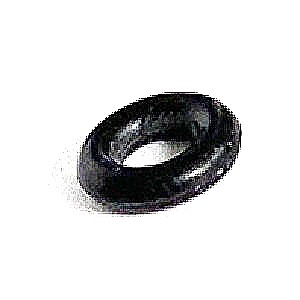
O-Ring (On/Off Valve Assembly) / Part No. 720310077
Product Name: O-Ring (On/Off Valve Assembly) / Part No. 720310077
Description:
This component is an O-ring, a circular elastomeric sealing ring specifically designed for the pneumatic on/off valve (water switch) assembly in high-pressure waterjet cutting systems . It is a precision-molded sealing component manufactured from high-durability elastomer materials such as Nitrile (NBR) or Viton (FKM), chosen for their excellent resistance to high-pressure water, hydraulic fluids, and temperature extremes .
The O-ring functions as a static or dynamic seal, preventing ultra-high-pressure water and hydraulic fluid from leaking between mating surfaces within the valve assembly. It is installed in a precision-machined groove in the valve body, cylinder head, or piston. When compressed between two mating components, the O-ring deforms to fill the gap, creating a reliable leak-proof seal under extreme pressure cycling . This specific part number (720310077) is identified as a genuine DARDI waterjet spare part .
Applications:
Seals static interfaces between the valve body and cylinder head in the water on/off valve assembly
Provides a dynamic seal on the valve stem or piston shaft to prevent water or air bypass
Suitable for ultra-high pressure waterjet systems operating at 60,000 PSI (approximately 4,137 bar) and above
Compatible with DARDI waterjet cutting systems and standard on/off valve assemblies
Features:
Elastomeric Construction: Manufactured from NBR, FKM, or EPDM rubber, offering excellent compression set resistance and chemical compatibility
Precision-Molded Dimensions: Produced to exact tolerances for proper fit within the designated gland groove
Compression Sealing: Designed to deform under compression, creating a reliable leak-proof seal without requiring high torque
Wide Temperature Range: Capable of performing consistently across operating temperatures from -30°C to +120°C depending on material grade
Critical Consumable Component: Subject to wear, hardening, and compression set over time; requires periodic replacement
Maintenance:
Failure Diagnosis:
External Water Leakage: Visible water weeping from the valve body connections or around the actuator rod indicates a worn or extruded O-ring
Abrasive Dust Contamination: Grit or abrasive particles found on external surfaces often indicate O-ring failure, allowing contaminants to bypass the seal
Hardening or Cracking: During disassembly, inspect O-rings for signs of hardening, cracking, or flattening (compression set). Any visible damage warrants immediate replacement
Inconsistent Valve Operation: If the on/off valve fails to open or close cleanly, worn O-rings may be causing friction or bypass issues
Replacement Procedures:
Always Replace During Service: O-rings are single-use consumable components. Always replace every O-ring with a new one whenever the valve assembly is disassembled . Do not reuse old O-rings
Clean Groove Thoroughly: Before installing a new O-ring, ensure the gland groove and mating surfaces are completely clean, dry, and free from debris, old seal residue, corrosion, or scratches
Lubrication: Apply a thin, uniform coating of manufacturer-recommended high-pressure grease to the O-ring during installation. This prevents pinching, rolling, or damage during assembly and prevents dry start-up
Check for Twists: Ensure the O-ring is not twisted or pinched in the groove after installation. An improperly seated O-ring will leak immediately under pressure
Correct Size Verification: Verify the new O-ring matches the exact dimensions of the original. An O-ring that is too thick may cause assembly damage; an O-ring that is too thin will not seal
Full Depressurization: Always fully depressurize the waterjet system (both hydraulic and high-pressure water circuits) and follow lockout/tagout procedures before disassembling the valve assembly
Preventive Replacement Schedule: It is standard practice to replace all O-rings in the on/off valve assembly during scheduled annual maintenance or after 800–1,000 operating hours to prevent unexpected seal failure and unplanned downtime
Water Quality Impact:
Poor water quality with contaminants or high hardness accelerates O-ring wear and degradation. Maintain proper water filtration to maximize seal life
Product recommendation
-
00080028-Pneumatic-ActuatorNormally-Closed-Cover
-
CJ311388 High Pressure Swivel Joints Swivel Body
-
10078905 Waterjet Cutting Pump Parts Coupling, .38 x .38, F/F
-
Water-Jet-Parts-O-RING-4100705-OR0759017-151
-
20437164 Directional Control Valve
-
10074821 O-ring
-
10097228 HP Water Jet Cutter Parts Cross, .25
